
Me, Marshall, and the Machine
a relationship between a girl, technology, and her favorite 20th century philosopher can be something so personal

I’ve been wanting to write something about my relationship with Technology for a while now. It’s tricky because I can’t decide how to frame it, which angle to take. I don’t want to get as micro as articulating my relationship with the Internet (that feels like a whole separate conversation), but I don’t know if I can talk about Technology without the Internet, and vice versa. The medium may be the message after all… It’s too much! I lack the words!
For my intents and purposes, there are two camps:
“Technology”
“The application of scientific knowledge for practical purposes”
Day to day use cases
Self-checkout, QR codes, facial recognition, television and audio (mediums)
A framework for tools
Automation of tasks
“The Internet”
A connected network of devices that transmits data and media
Its own universe
When I talk about the Internet, I’m almost always talking about its social elements. The posting/sharing of content and interaction from users on platforms like Tumblr, YouTube, Twitter, Reddit, etc…
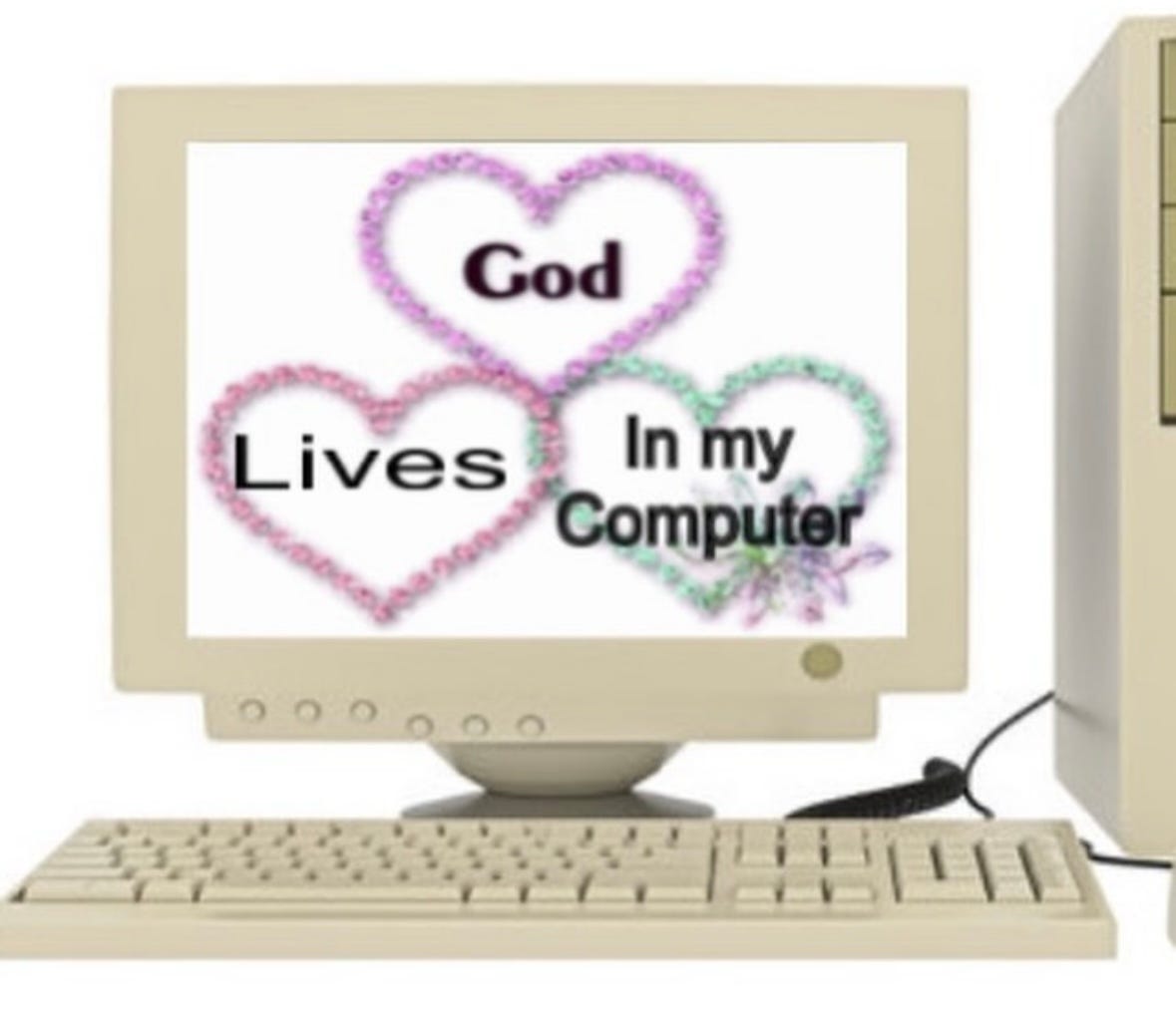
My new strategy for Getting Over Myself is taking the approach of “well, what would I like to read?” And what I want to read is a personal essay that tries to reconcile a hyper-techno progress focused society with the undeniable truths of the human spirit. I want to read about the constant cognitive dissonance that comes from living in said society and feeling like you’re going insane every day. I want to read about whether God lives in the Cloud!
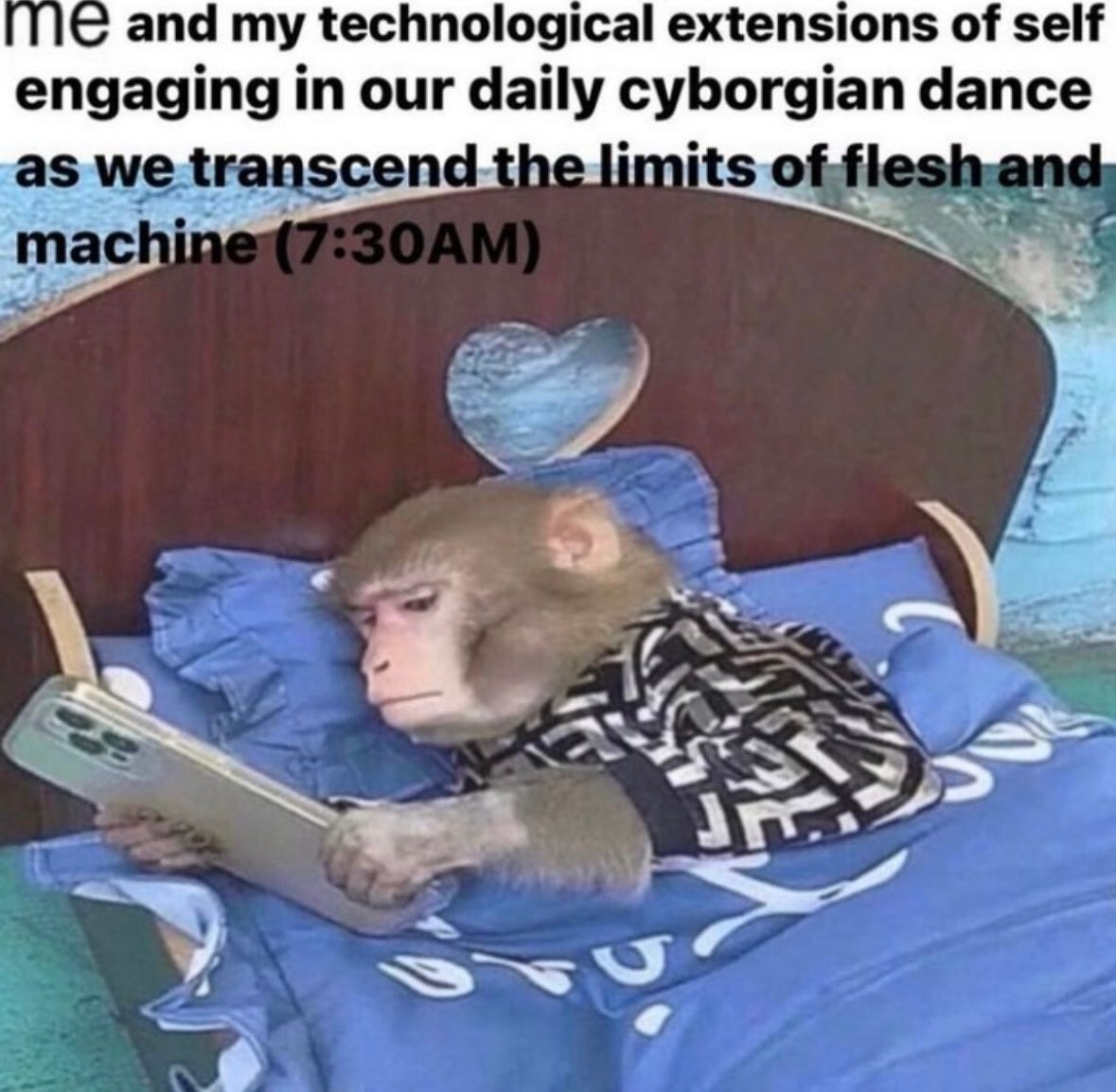
Working adjacent to the tech industry has been ... illuminating. In each meeting where regulatory policy or product development or the latest in AI is on the agenda, I can feel it creep up my throat. The Neo-Luddite gremlin that angrily schemes inside my ribcage whenever a co-worker suggests using ChatGPT to send an email or a speaker at a conference hails generative AI as the next industrial revolution.
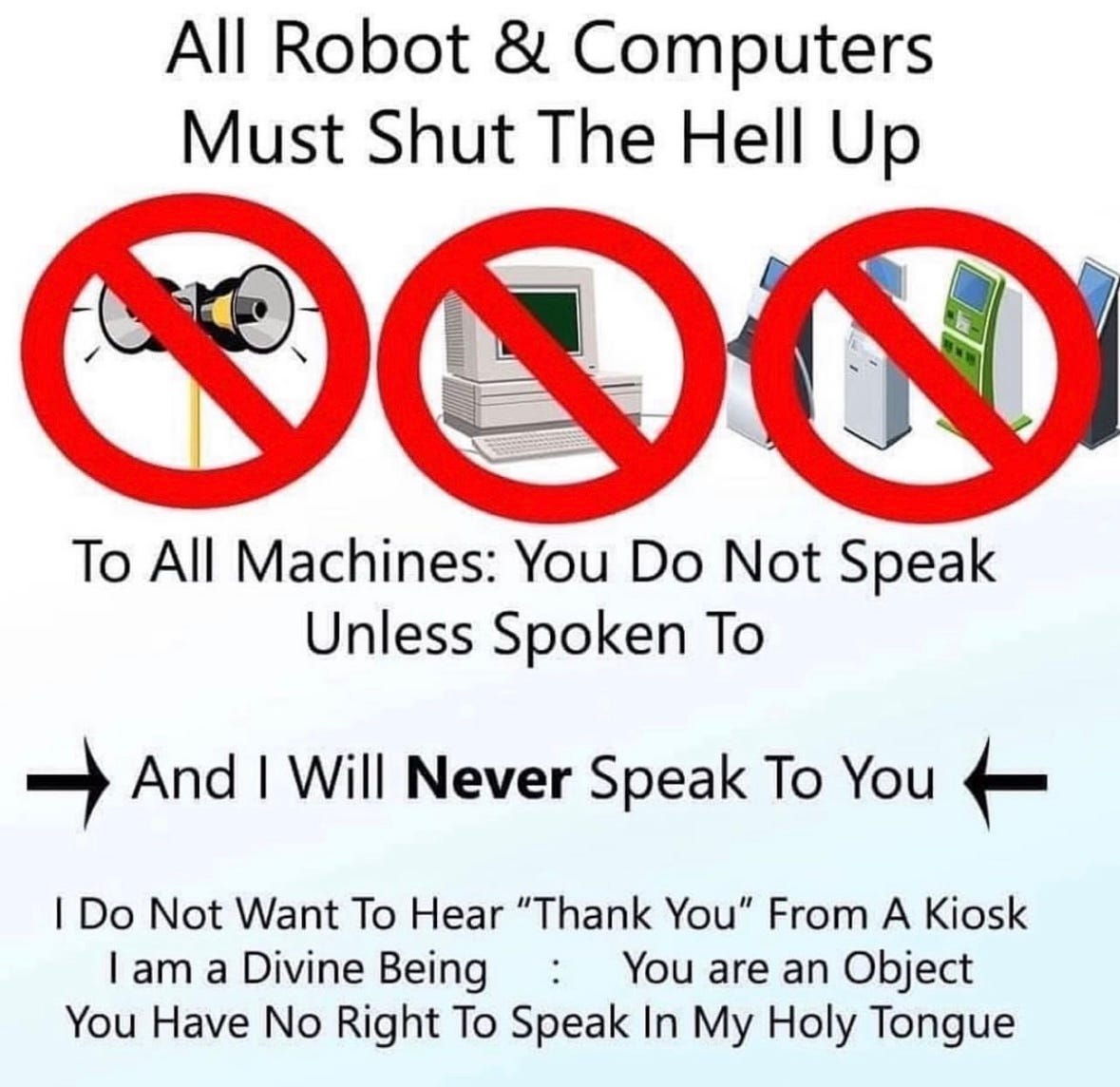
In the 19th century, against the backdrop of European land wars and dire economic realities for working class people, British textile workers started breaking into factories and destroying machinery associated with the loss of their livelihoods. Named after the folkloric Ned Ludd, the Luddites hoped their instigating and chaos would stop employers from installing the new machines. But they were unsuccessful in slowing this adoption and their efforts were squashed through military response. Today “Luddite” is used derogatorily, synonymous with “small-minded” and smugly painting someone as a foolish opponent of humanity’s march towards progress. The term Neo-Luddite is used now to refer to the skeptics of tech bros and the Silicon Valley machine - still smug. The Luddites had real grievances with their era’s “technological progress”. Advances in technology slowly killed off widespread artisanal craftsmanship and added to the social unrest of the 19th century. Their knee-jerk reactions were based in real fears and we’ve seen similar reactions throughout the centuries at each technological inflection point (like with the Romantics).
It’s dangerous for a society to hold nebulous Progress as its sole value and raison d'etre. It’s dangerous to paint people as against the inevitable, a “you’re either with us or you’re against us”. The promise of new technology that brings a better future is not always guaranteed. In time, I believe the Luddites will be vindicated. Anyone with a brain should be wary towards AI’s forced implementation into every aspect of our lives. Treating advancements in technology as inherently good and its full-throated embrace doesn’t always leave room to ask - “why now?”, “what will this change?”, and “who will this harm?”. Speaking of vindication, no one has done more to influence my view of technology and its influence on our post-modern culture than Marshall McLuhan.
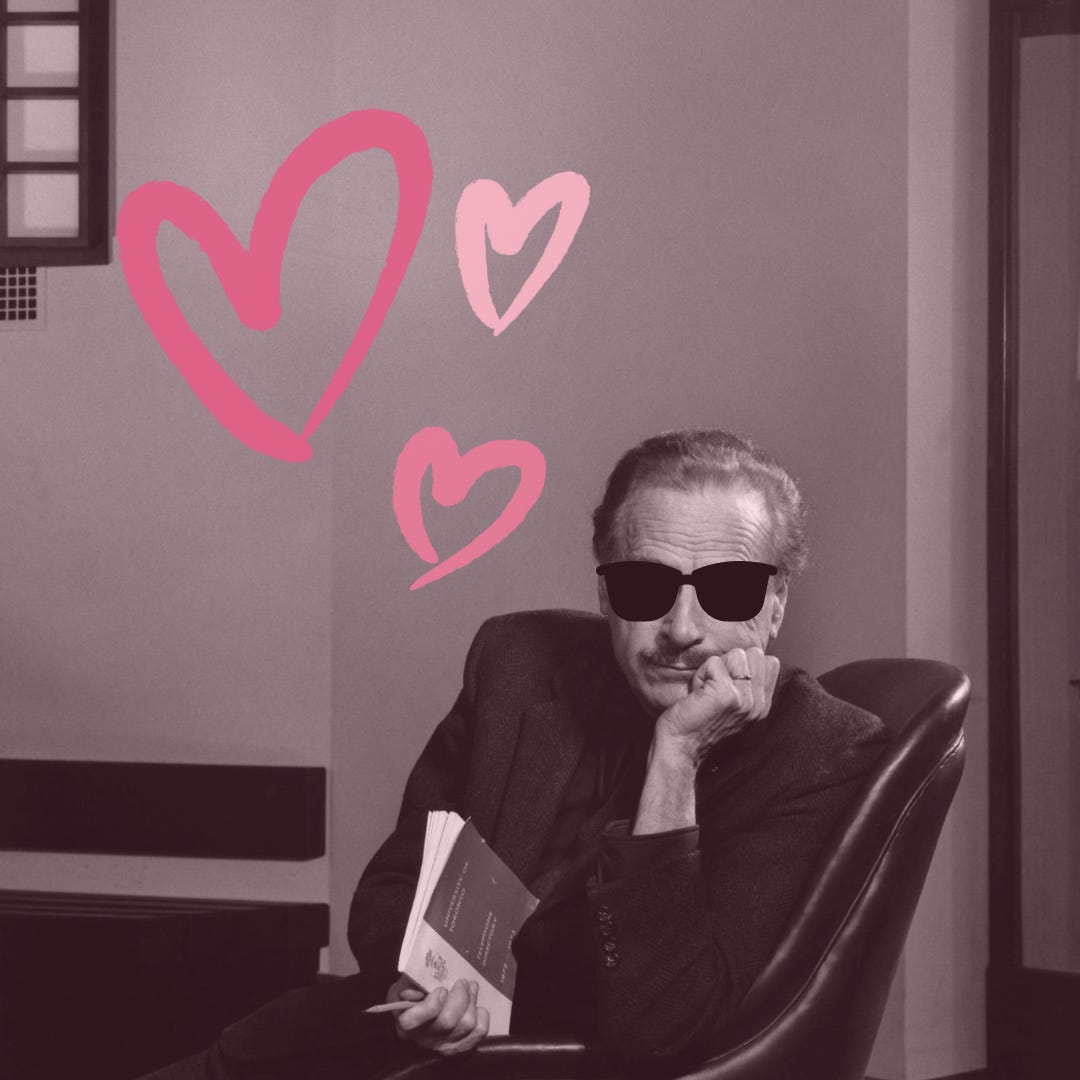
Marshall McLuhan the man that you are
“In a culture like ours, long accustomed to splitting and dividing all things as a means of control, it is sometimes a bit of a shock to be reminded that, in operational and practical fact, the medium is the message. This is merely to say that the personal and social consequences of any medium - that is, of any extension of ourselves - result from the new scale that is introduced into our affairs by each extension of ourselves, or by any new technology." - Understanding Media: The Extensions of Man by Marshall McLuhan
For those who aren’t communications majors or who just don’t know, let me give a brief overview of Canadian scholar Marshall McLuhan, a man who wasn’t “right” about everything but when he was right… he was right.
McLuhan is the founding father of media studies who coined the concepts of “the medium is the message” and the “global village”. He was prolific, constantly publishing, constantly being interviewed, and referenced in pop culture content (The Sopranos and Annie Hall for example). Marshall McLuhan is one of the most vindicated thinkers on today’s Internet for his premonitions and insights. He died decades before the birth of the web but his work had a renaissance and his spirit is felt in today’s mass media landscape. “Marshall McLuhan talks about this” are words that leave my mouth too often for my liking. But he had so much to say!
On faith (McLuhan was an adult convert to Catholicism)
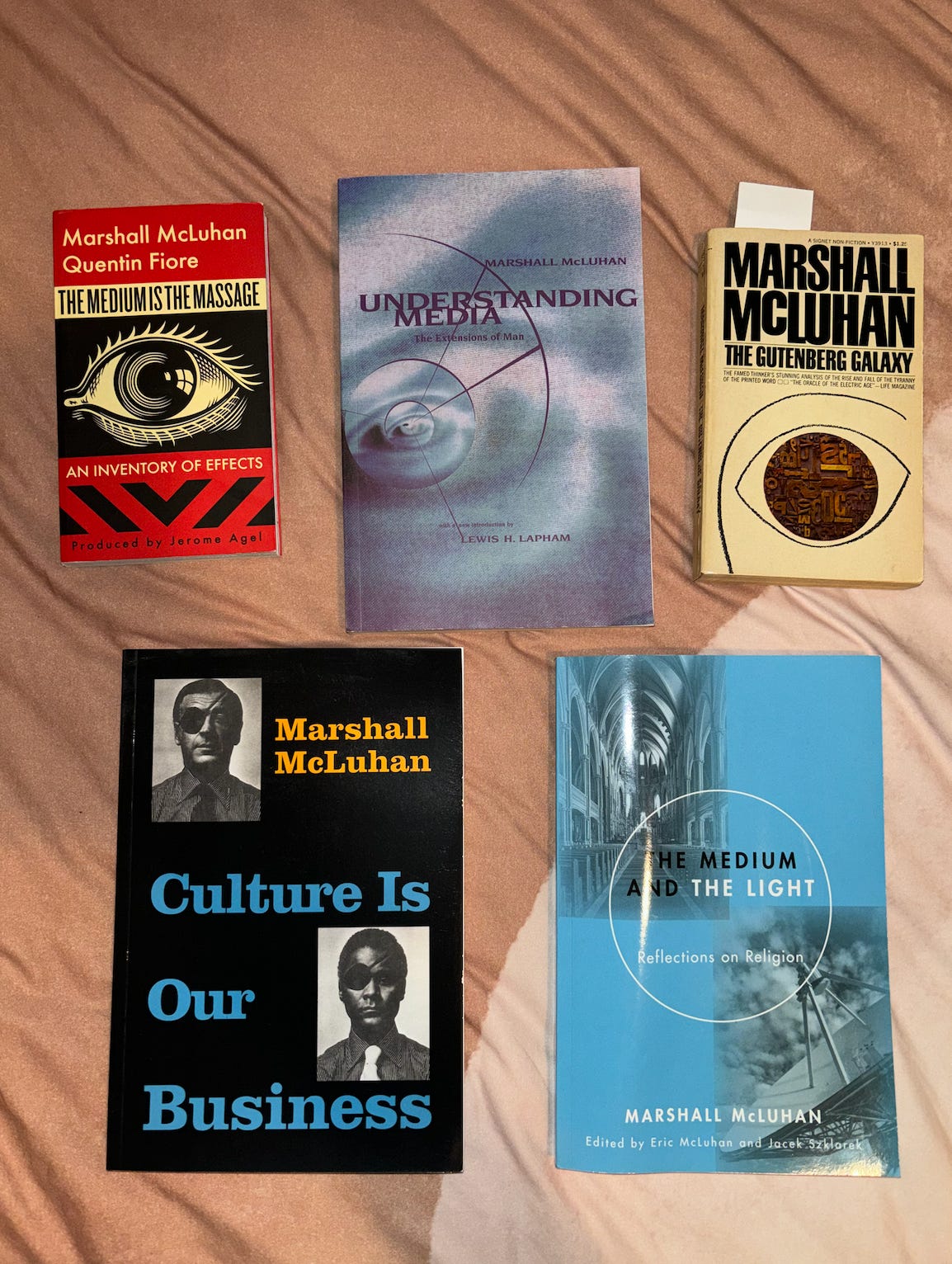
McLuhan isn’t a theologian, but analyzing his work through the lens of Catholicism enriches it for me. Medium and the Light: Reflections on Religion, a collection of McLuhan’s writings that touch on religion, compiles his notes on the traditions of Western Christianity in the face of developments in technology. Post-Vatican II discourse is my niche and McLuhan does a great job at weaving together parallels between the rapid changes in technology and the midcentury Christian moment. McLuhan had this to say about the adoption of new technologies paired with changes in Catholic liturgy circa the 1960s-
“These essential aspects of liturgical change were neither predicted nor programmed, and they remain unnoticed by the users of church resonance. (…) I merely suggest that these results come from a typical visual Western mentality as it approaches technological innovation. As soon as a new means of communication arises, we feel driven to adopt it without considering either the aim or the consequences.”
He predicted the internet as an echo chamber - RIP Marshall McLuhan you would have loved talking about TikTok cancel culture being a response to the reactionary tribalism of globalism!
On Hot vs Cool media
Hot media = more information is being communicated and viewer is simply absorbing what’s presented with little work on their end (eg watching videos). There’s a lot of this flying around today, which I blame for frying our attention spans and dopamine receptors. “I didn’t get the plot of the movie!” You were on your phone watching TikTok videos the entire time… and you’re shocked you didn’t get the plot of the movie?
Cool media = less information and the viewer has to be familiar enough with the media’s conventions to do some of the legwork (eg reading comics).
Media as an extension of our bodies - technology can free us from the physical constraints but at what cost?
Etc, etc, etc …
I don’t know why I latched onto McLuhan so zealously. Perhaps it’s because I’m also an obnoxious Catholic. Too often are these philosopher types judged based on how “right” their predictions were. As if fidelity to the zeitgeist determines the worth of your contributions. In YouTube comments, there’s always someone referencing how “eerie” his visions of a future society are and how amazing it is that so many of his theories materialized. It is amazing, but accurate predictions are a side-effect of having a big, sexy brain. And it’s Marshall McLuhan’s world, we’re just living in it.
But we can never go back
A collapse of our infrastructure aside, technology will continue to progress and evolve and affect. Maybe the manmade horrors beyond our comprehension won’t actually be that bad... I don’t want to entrench myself so deeply into a Neo-Luddite (hypocritical) position because at the end of the day, I am a girl on the computer.
I refresh my social apps to survey what people are up to and what they’re saying. I write this on a laptop and keep my tabs of research open right next to my beloved books. I’ve carefully scrolled through miles of memes over years to find the ones I share here. My very introduction to Marshall McLuhan was from an Instagram meme page. Despite its horrors and chaos, I love the Internet. I love feeling connected to the thoughts and ideas of others. But where is the line?
I feel lucky to be born at just the right time to experience a world where Technology and the Internet’s reach were less pervasive, contained to a single room in a house. I’m sure generations before feel similarly. I think about the intersection and tension between art and technology, the decrease in quality of our valued artifacts, Martin Scorsese’s op-ed, the effects of a tech centered world on the humanities and on future generations, etc… Can kids today even read??? It feels like every cultural artifact I care about is slowly being corroded into nothing from a double-whammy of commercial forces and junkification. We don’t need a collection of essays to come to the same conclusion - this “brain rot” disease is endemic and technology is fueling its spread with a systemic erosion of critical thinking/media literacy skills. But hey, at least the memes are so, so good.
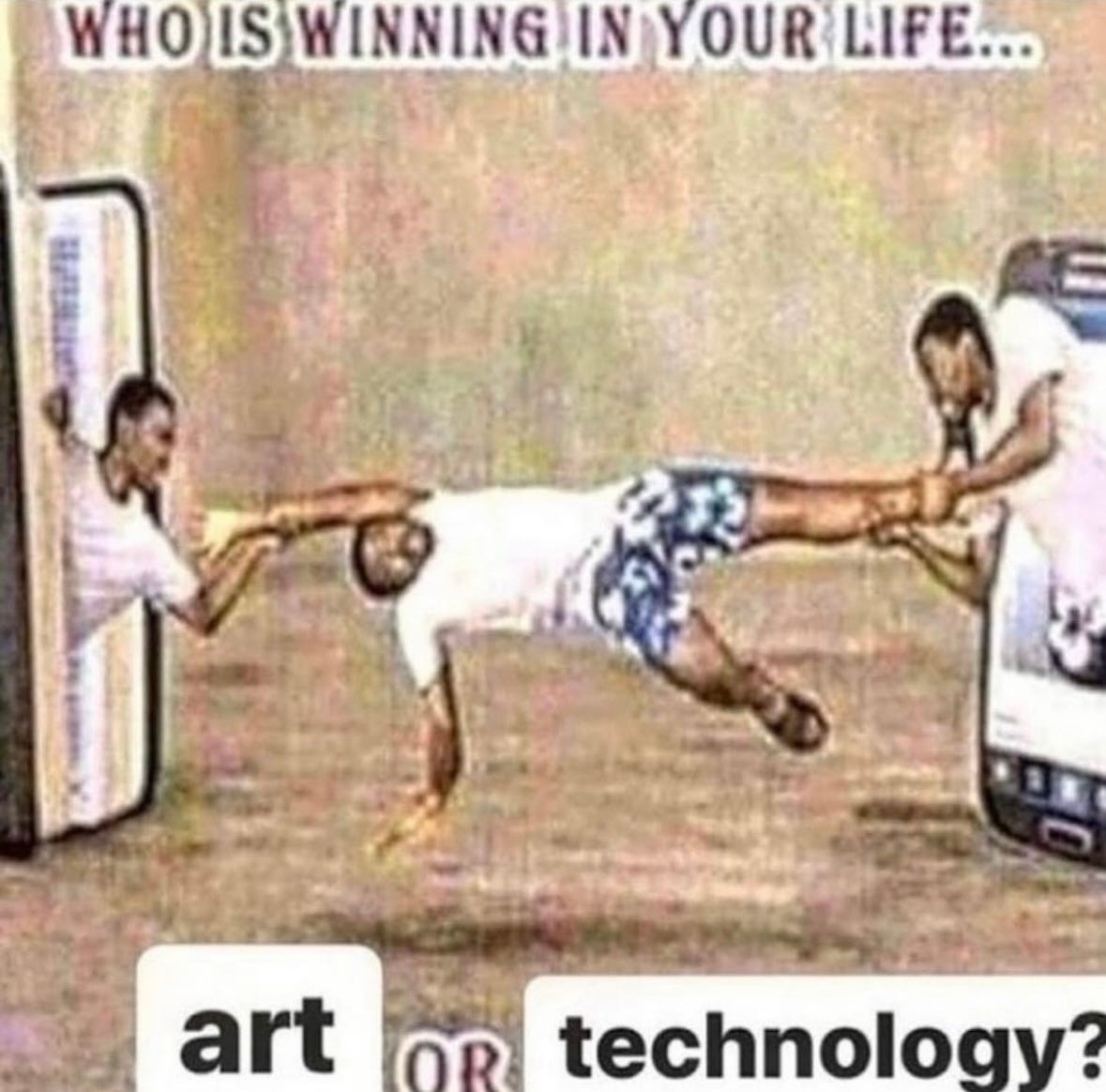
McLuhan believed that the content inside of mediums was irrelevant, that the medium itself was enough to shape society and have an impact. But when everything is a transmission, everything is a medium… what then? Does the content suddenly matter now more than before? Where I lack the words, I can at least identify the feelings. It stresses me out that the human experience is changing and not always for the better (just look at all the modern dating/dating app discourse). I worry that the next generation will not be able to fully appreciate the rich legacy of human thought and artistry. There is more to life than what technology confines us to and there is zero point to technological progress if we abandon ourselves in the process. Just because you live in the machine doesn’t mean you have to become one.
Further Reading
If you made it this far, thanks for indulging me and my incoherent ramblings. Below is my humble collection of McLuhan works and some fave tech adjacent articles I frequently reference.
Marshall McLuhan’s 1969 Playboy Magazine interview is actually a pretty concise and approachable summary of his key arguments.
As a lover of niche aesthetics and curated visuals, I love perusing the CARI index. It’s fascinating to see how technology’s pushes and pulls are reflected in our visual language. The rapid evolution of technology is seen everywhere here, exploding with each decade.
The Zoom Gaze by Autumn Caines - reading this ~ 1 year into the pandemic really helped explain why I hated being on camera for Zoom meetings.
The Age of Instagram Face by Jia Tolentino - constantly cited for a reason.
Your phone is why you don’t feel sexy by Catherine Shannon - case beautifully stated, the medium is the message!!!
🤠